 OpenLET
 ModelScope
 Hugging Face
Abstract摘要 #
Vision-Language-Action (VLA) foundation models have recently demonstrated impressive open-domain manipulation skills, yet most public benchmarks and deployments remain centered on household and tabletop settings. Industrial manipulation imposes a substantially different set of requirements: narrow tolerances, long-horizon multi-stage assembly, heterogeneous tooling, and a hard expectation of high, repeatable success rates under fixed line-side conditions.
视觉-语言-动作(VLA)基础模型近年来展现出令人瞩目的开放域操作能力,但目前公开的基准测试与部署大多仍局限在家庭和桌面场景。工业操作提出了一套截然不同的要求:狭窄的公差、长程多阶段装配、异构工具,以及在固定产线条件下对高且可复现成功率的硬性要求。
We present KUAVO-VLA-1.0, a domain-specialized vision-language-action foundation model (DSFM) purpose-built for dual-arm humanoid manipulation in industrial scenarios on the Kuavo humanoid platform. KUAVO-VLA-1.0 is obtained through a two-stage pipeline on top of LingBot-VLA-2.0, a large-scale pretrained VLA foundation model. The first stage, domain-specific retraining, trains on a self-collected corpus of 100 industrial manipulation tasks totaling 680 hours of dual-arm teleoperated demonstrations, instilling broad industrial-domain competence and cross-task transfer — this is what turns a general-purpose backbone into a DSFM. The second stage, task-specific post-training, specializes the DSFM on individual tasks to push per-task reliability toward production-grade success rates.
我们提出 KUAVO-VLA-1.0,一个专为 Kuavo 人形平台上双臂工业操作场景打造的垂域视觉-语言-动作基础模型(DSFM)。KUAVO-VLA-1.0 是在大规模预训练的 VLA 基础模型 LingBot-VLA-2.0 之上,经由两阶段流程得到的。第一阶段——垂域再训练(domain-specific retraining)——在自采的 100 个工业操作任务、总计 680 小时的双臂遥操作示教语料上训练,赋予模型广泛的工业领域能力与跨任务迁移能力——这正是把通用骨干模型转变为 DSFM 的关键一步。第二阶段——单任务后训练(task-specific post-training)——在具体任务上对 DSFM 做专项优化,把单任务可靠性推向生产级的成功率。
We evaluate KUAVO-VLA-1.0 on a 25-task industrial manipulation benchmark — 20 industrial tasks plus 5 unseen in-domain tasks (GM100) — against a panel of state-of-the-art VLA baselines (π0.5, GR00T N1.7, and LingBot-VLA-2.0 itself, which as our own backbone isolates domain specialization with architecture and pretraining held fixed). To support reproducible research on DSFMs for real industrial deployment, we release the technical report, this project webpage, training code built on our open-source LeTools framework, model checkpoints, and the underlying industrial manipulation dataset, released on the OpenLET platform.
我们在一个 25 任务的工业操作基准上评测 KUAVO-VLA-1.0——其中 20 个是工业任务,另外 5 个是域内未见任务(GM100)——对比一组业界领先的 VLA 基线(π0.5、GR00T N1.7,以及 LingBot-VLA-2.0 本身——作为我们自己的骨干模型,在架构与预训练完全相同的前提下,它能单独衡量垂域化带来的提升)。为支持面向真实工业部署的 DSFM 可复现研究,我们公开了技术报告、本项目主页、基于我们开源的 LeTools 框架构建的训练代码、模型权重,以及底层的工业操作数据集——发布在 OpenLET 平台上。
Method方法 #
We do not propose a new backbone. We treat industrial deployment as a domain-adaptation problem and design a two-stage pipeline on top of a general-purpose VLA foundation model. 我们并未提出新的模型骨干。我们把工业部署视为一个域适配(domain-adaptation)问题,并在一个通用 VLA 基础模型之上设计了一套两阶段流程。
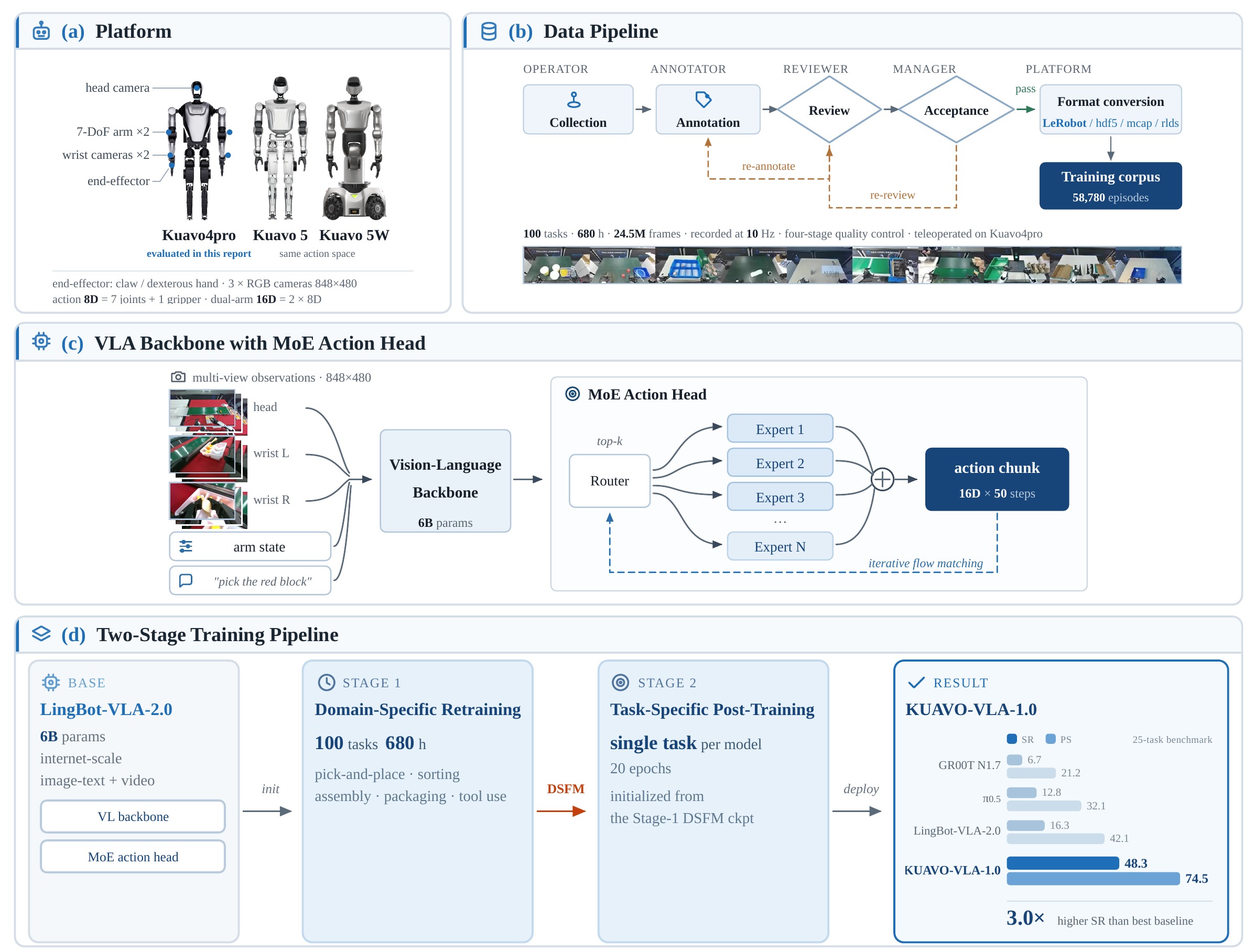
which_arm determines whether the action head predicts an 8-dimensional single-arm or 16-dimensional dual-arm chunk.
Kuavo4pro 上的配置空间(a)、数据采集与处理流程(b)、模型架构(c),以及两阶段训练流程(d)。末端执行器与激活手臂的选择是部署时的配置项而非写死的——which_arm 决定动作头预测的是 8 维单臂动作块还是 16 维双臂动作块。
A large-scale pretrained vision-language-action foundation model: a vision-language understanding backbone pretrained on internet-scale image-text and video data, coupled with a Mixture-of-Experts action head that refines noised action tokens into a denoised action chunk via flow matching. The policy consumes one head camera, two wrist cameras, and proprioceptive arm state. LingBot-VLA-2.0 is also evaluated as a baseline in Results, isolating what domain-specific retraining adds on top of an identical backbone. 一个大规模预训练的视觉-语言-动作基础模型:视觉-语言理解骨干在互联网规模图文与视频数据上预训练,搭配一个混合专家(MoE)动作头,通过 flow matching 把加噪动作 token 逐步还原为去噪后的动作块。策略输入为一路头部相机、两路手腕相机与本体感知的手臂状态。LingBot-VLA-2.0 同时也作为 Results 中的一个基线被评测,用来在骨干完全相同的前提下,单独衡量垂域再训练带来的提升。
Retraining on 100 distinct industrial tasks (680 hours) turns the general-purpose backbone into a domain-specialized foundation model (DSFM): it shifts the visual and behavioral distribution toward line-side fixtures, connectors, packaging, and tooling — all underrepresented in general-purpose corpora. Spanning pick-and-place, sorting, assembly and insertion, packaging, and tool-based operations, this stage is designed to encourage positive skill transfer across tasks. 在 100 个不同的工业任务(680 小时)上做再训练,把通用骨干模型转变为一个垂域基础模型(Domain-Specialized Foundation Model, DSFM):这一阶段把视觉与行为分布迁移到产线现场的治具、接插件、包装与工具场景——这些在通用语料里都严重欠代表。该阶段覆盖抓取放置、分拣、装配插接、包装与工具类操作,旨在促成任务间的正向技能迁移。
A lightweight per-task stage starting from the DSFM checkpoint produced by Stage 1. Because the model already holds broad industrial competence, this typically needs far fewer demonstrations and steps than specializing from the general backbone directly, while reaching higher final success rates. 一个从 Stage 1 产出的 DSFM checkpoint 出发的轻量级单任务阶段。由于模型已具备广泛的工业领域能力,相比直接从通用骨干模型专项化,通常只需少得多的示教数据和训练步数,却能达到更高的最终成功率。
Dataset数据集 #
The corpus comprises 100 industrial manipulation tasks, 58,780 demonstration episodes and 24.5M synchronized frames — 680 hours at the native 10 Hz recording rate. All training data is collected by teleoperation on physical Kuavo dual-arm humanoids across real industrial scenarios. Raw ROS bags are screened by operator review, converted into standardized episodic trajectories with synchronized multi-view RGB, proprioceptive state, and language annotations, then filtered again automatically before entering the corpus. The resulting dataset is released on the OpenLET platform. 语料包含 100 个工业操作任务、58,780 段示教 episode、2447 万帧同步画面——按 10 Hz 原生记录速率计为 680 小时。全部训练数据都是在真实工业场景中,通过实体 Kuavo 双臂人形机器人遥操作采集的。原始 ROS bag 先经人工审核筛选,转换为带同步多视角 RGB、本体状态与语言标注的标准化 episode 轨迹,再经过一轮自动过滤后进入语料库。最终数据集发布在 OpenLET 平台上。
Benchmark评测基准 #
Twenty-five industrial manipulation tasks on the Kuavo dual-arm humanoid, spanning the same skill categories as the domain-specialization corpus. Twenty of them also appear in the 100-task Stage 1 corpus, so those measure task-specific specialization on already-seen tasks. The remaining five are unseen in-domain tasks from the GM100 collection, exercising the same Kuavo4pro dual-arm manipulation skills but held out of the Stage 1 corpus. Each task is evaluated over multiple real-robot rollouts with fixed initial-condition randomization. 25 个在 Kuavo 双臂人形机器人上的工业操作任务,覆盖与垂域语料相同的技能类别。其中 20 个同时也出现在 100 任务的 Stage 1 语料里,衡量的是在已见任务上的单任务专项化能力;剩余 5 个是来自 GM100 集合的域内未见任务,运用相同的 Kuavo4pro 双臂操作技能,但被留出 Stage 1 语料。每个任务都在固定初始条件随机化下进行多次真机 rollout 评测。
Full 25-task list完整 25 任务列表 filter by category按类别筛选
| # | Category类别 | Task prompt任务指令 | Stage 1Stage 1 |
|---|
Each benchmark task is initialized from the Stage 1 checkpoint and task-specifically post-trained for 20 epochs. 每个评测任务都从 Stage 1 checkpoint 初始化,并做 20 个 epoch 的单任务后训练。
Demo footage演示视频
Real-robot rollouts of KUAVO-VLA-1.0 on six of the benchmark's key scenarios. SR — success rate, the share of rollouts that complete the task end-to-end; PS — progress score, the mean fraction of a task's steps completed. KUAVO-VLA-1.0 在六个重点评测场景下的真机 rollout 实拍。SR——成功率,完整走完全流程的 rollout 占比;PS——过程分,已完成步骤占比的均值。
Unseen in-domain tasks (GM100)域内未见任务(GM100)
Five tasks from the public GM100 collection, held out of the Stage 1 corpus and adapted only in Stage 2. 来自公开 GM100 集合的 5 个任务,未进入 Stage 1 语料,仅在 Stage 2 适配。
Results结果 #
Full 25-task benchmark — 20 industrial tasks (also in the 100-task Stage 1 corpus) plus 5 unseen in-domain tasks — each task evaluated over multiple real-robot rollouts with fixed initial-condition randomization. KUAVO-VLA-1.0 (task-specific) is the DSFM after Stage 2 per-task post-training. GR00T N1.7 and π0.5 are evaluated as external baselines under the same protocol; LingBot-VLA-2.0 is evaluated too — it is also the backbone KUAVO-VLA-1.0 is built from, so this comparison isolates what domain-specific retraining adds with architecture and pretraining held fixed. See Seen vs. unseen tasks below for the seen/unseen split. 完整 25 任务基准测试——20 个工业任务(同时也在 100 任务的 Stage 1 语料里)加上 5 个域内未见任务——每个任务在固定初始条件随机化下经过多次真机 rollout 评测。KUAVO-VLA-1.0(task-specific)是叠加了 Stage 2 单任务后训练的 DSFM。GR00T N1.7 与 π0.5 作为外部基线在相同协议下评测;LingBot-VLA-2.0 同样被评测——它也是 KUAVO-VLA-1.0 的骨干模型,因此这一对比能在架构与预训练完全相同的前提下,单独衡量垂域再训练带来的提升。工业/公共任务的拆分对比见下方已见 vs 未见任务。
Success rate & progress score成功率 & 过程分
SR — share of rollouts that complete the task end-to-end; PS — mean fraction of each task's steps completed, credited even on rollouts that fall short. Mean over all 25 tasks; all four systems fully evaluated (25/25). SR(成功率)——完整走完全流程的 rollout 占比;PS(过程分)——每个任务已完成步骤占比的均值,即使未完全成功也计入部分得分。25 个任务上的均值;四个系统均已全部评测完成(25/25)。
All four systems above are evaluated on the complete 25-task benchmark under a matched real-robot protocol. 以上四个系统均已在相同的真机评测协议下完成完整 25 任务基准的评测。
Seen vs. unseen tasks已见 vs 未见任务 #
The 25-task benchmark pairs 20 industrial tasks, all present in the 100-task Stage 1 corpus, with 5 unseen in-domain tasks from the GM100 collection, which exercise the same Kuavo4pro dual-arm manipulation skills but were held out of Stage 1. On the unseen group, after the same 20-epoch task-specific post-training, KUAVO-VLA-1.0 still leads at 42.7% SR against 25.3% for LingBot-VLA-2.0, its own backbone — the 1.7× gap indicates that domain-specific retraining instills transferable manipulation skill rather than rote memory of the training tasks. Two caveats bound this: these are public tasks with published demonstrations, adapted under the same 20-epoch budget, not zero-shot evaluations; and they differ from the seen tasks in scene rather than in embodiment or skill, so this is evidence of skill transfer to unseen in-domain tasks, not of zero-shot generalization. 25 任务基准将 20 个工业任务(全部出现在 100 任务的 Stage 1 语料中)与 5 个域内未见任务(,来自 GM100 集合,运用相同的 Kuavo4pro 双臂操作技能,但被留出 Stage 1 语料)配对。在未见任务组上,经过相同的 20-epoch 单任务后训练,KUAVO-VLA-1.0 仍以 42.7% 的 SR 领先于其自身骨干 LingBot-VLA-2.0 的 25.3%——这 1.7 倍的差距说明垂域再训练注入的是可迁移的操作技能,而非对训练任务的机械记忆。两点需注意:这些是带公开示教数据的公共任务,在相同的 20-epoch 预算下适配,并非零样本评测;且它们与已见任务的区别在于场景而非构型或技能,因此这体现的是向域内未见任务的技能迁移,而非零样本泛化。
| Model模型 | SR | PS | ||
|---|---|---|---|---|
| Seen 20已见 20 | Unseen 5未见 5 | Seen 20已见 20 | Unseen 5未见 5 | |
| GR00T N1.7 | 8.3% | 0.0% | 22.5% | 16.2% |
| π0.5 | 12.3% | 14.7% | 32.9% | 28.8% |
| LingBot-VLA-2.0 | 14.0% | 25.3% | 40.1% | 49.7% |
| KUAVO-VLA-1.0 (task-specific专项) | 49.7% | 42.7% | 74.1% | 76.2% |
Per-task breakdown逐任务明细 25 tasks × SR / PS25 个任务 × SR / PS
Success rate (SR) and progress score (PS) by task, shown as two separate rows per system — on many of the harder tasks SR alone is 0% for most systems, but PS shows how far they actually got. Task codes are our internal task IDs; titles are our own short-form translations and are independent of the task-prompt wording used in the Benchmark table above. The 5 cards tagged Unseen are unseen in-domain tasks from the GM100 collection — see Seen vs. unseen tasks above for the aggregate comparison. 按任务分别展示成功率(SR)与过程分(PS),每个系统各占独立一行——不少较难的任务上多数系统 SR 是 0%,但 PS 能看出它们实际走到了哪一步。任务编码是我们内部的任务 ID;标题是原始任务名,与上方 Benchmark 表格里使用的任务指令措辞相互独立。标有未见标签的 5 张卡片是来自 GM100 集合的域内未见任务——汇总对比见上方已见 vs 未见任务。
BibTeX #
@techreport{kuavovla2026,
  title  = {KUAVO-VLA-1.0: A Domain-Specialized Vision-Language-Action
            Foundation Model for Industrial Dual-Arm Humanoid Manipulation},
  author = {Leju Robotics},
  year   = {2026},
  institution = {Leju Robotics}
}